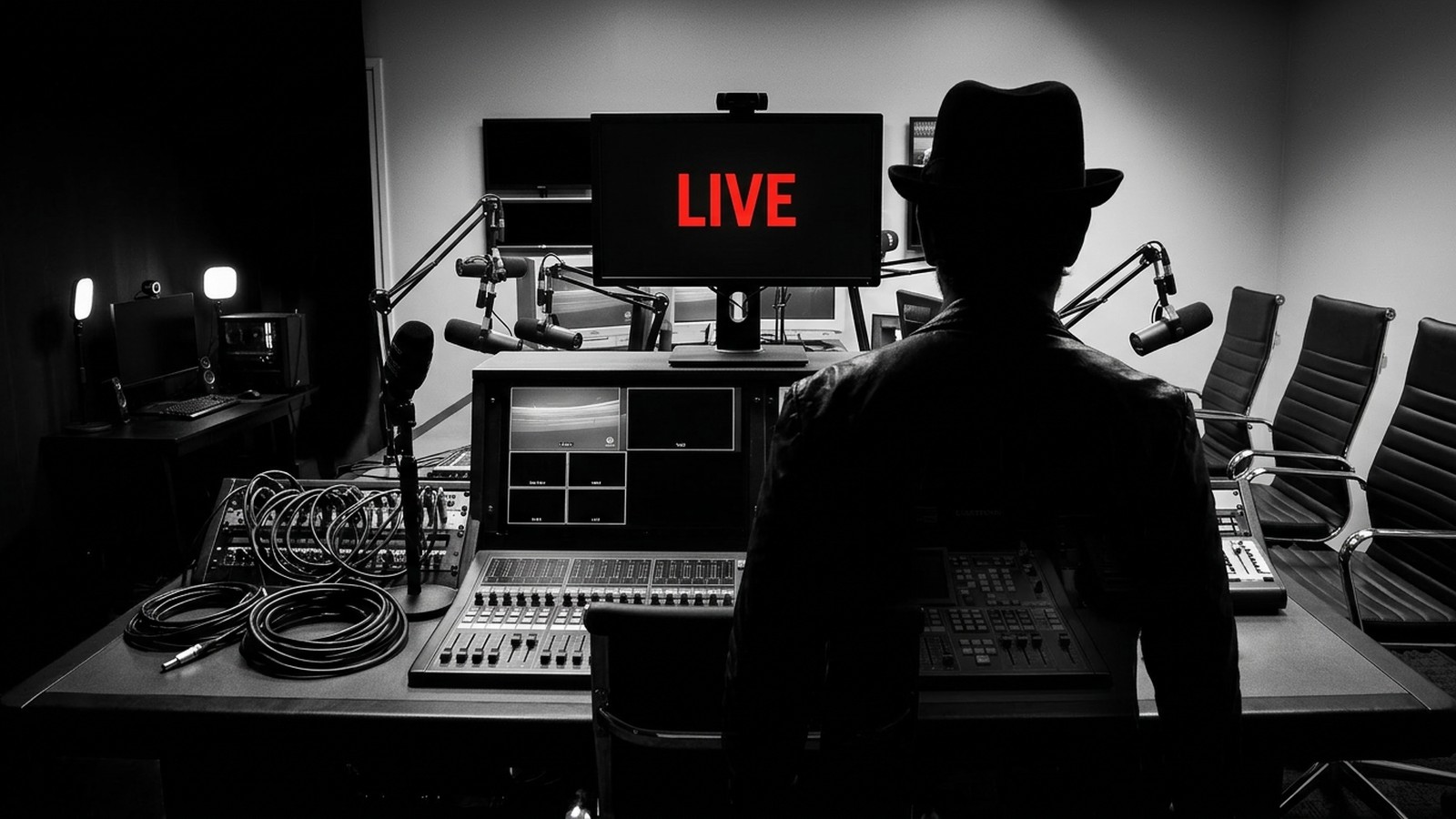
Most people still think live streaming is a toy.
That is not an insult. It is an observation. And to be fair, a lot of what has passed for live streaming over the past decade has looked exactly like a toy. Gamers in bedrooms. Influencers yelling at phones. TikTok battles. Random webcams. Chaotic comment threads powered by attention-begging and impulse. The whole scene read as unserious — loud, messy, and easily dismissed by anyone who already had a media strategy that was working.
But here is the thing about every major media shift: it looks weird before it looks obvious. It looks unserious before serious people understand what is actually happening inside it. It looks like a toy right up until the moment it becomes infrastructure.
That is exactly where live streaming is right now.
Feature vs. Format
There is a distinction that most people building in this space have not yet made, and it is the distinction that separates the people who will matter from the people who will be confused in three years wondering how they missed it.
The difference is between a feature and a format.
A feature is something you turn on. A format is something people return to. A feature is a button on a platform. A format is a ritual in someone's week. Going live has been a feature for years — on YouTube, on Instagram, on LinkedIn, on Twitch. Anyone can press it. Anyone can open a camera and start talking. That part is no longer impressive, and it is no longer a signal of anything meaningful.
The real question — the one that separates serious builders from casual users — is this: Can you build something people want to come back to?
Can you create a room with energy? Can you hold attention and make the audience feel like they are inside something rather than watching something? Can you build rhythm — recurring segments, familiar beats, a reason to show up tomorrow at the same time? Can you make the live experience feel like attendance rather than consumption?
That is where live streaming grows up. Not when more people go live. When better formats get built around it.
Broadcasting Impulse Is Not Media
Most live content today still operates on impulse. Someone has a thought, opens a stream, talks for twenty minutes, answers a few comments, and disappears. There is nothing wrong with that as a behavior. But that is not media. That is broadcasting impulse.
Media needs structure. It needs expectation — a consistent time, a consistent voice, a consistent promise to the audience. It needs recurring moments that become familiar enough to be anticipated. It needs tension, because tension is what holds attention. It needs community memory — the accumulated sense that regulars are rewarded for showing up.
These are not new principles. They are the principles that built radio. That built morning television. That built sports as a cultural institution. The formats that dominate a generation are always the ones that figure out how to make attendance feel necessary — not convenient, not optional, but necessary.
Live streaming is arriving at that same inflection point. The early chaos is not the destination. It is the origin story.
Presence Is the New Differentiator
The timing here matters enormously, and it has everything to do with what AI is doing to the content ecosystem around us.
AI can generate the post. The script. The image. The voice. The clip. The recap. AI can make almost everything look polished and credible at a scale no individual creator can match alone. Polish is no longer a differentiator. If your competitive advantage is that your content looks good and reads well, you are already in a race you are not going to win.
What AI cannot replicate is real-time presence.
The ability to think while the room is watching. To listen and adjust mid-sentence. To push back on a guest in the moment. To laugh when something unexpected happens and make the audience feel the electricity of that surprise. To call something out, sit in silence, hold a beat, and let the room breathe. That is not a content strategy. That is a skill. And it is becoming the most valuable kind of media skill there is, precisely because it cannot be automated.
Live has something edited content has never had: stakes. Something can go wrong. Something can surprise everyone. A moment can happen that nobody planned and that nobody could have scripted. The audience can feel the room shift in real time, and that feeling — of being present for something uncontrolled — is what separates the experience of live from the experience of consumption.
That is why sports still dominate culture. That is why live radio mattered in a way that podcasts do not quite replicate. Liveness creates scarcity. When everything is available anytime, nothing feels like it has to be attended. Live changes that. It brings back attendance — the feeling of being in the room before the moment disappears.
The Morning Slot Is the Most Underbuilt Room on the Internet
If there is one place where the transition from live streaming as a toy to live streaming as serious media infrastructure is most obvious — and most underbuilt — it is the morning.
Mornings are not just another content slot. They are where people calibrate for the day. Where attention is most open and most vulnerable. Where the first voice, the first frame, the first energy a person encounters sets the tone for the next twelve hours. What currently occupies that slot for most people? The feed. The inbox. The headlines. The outrage cycle. The algorithm making its best guess about what will hook you in the next three seconds.
That is a terrible way to start a day. And it represents an enormous opportunity for the creators and builders who understand what live format design can actually do.
A well-designed live morning room is not a person talking at a camera. It is a designed experience — structured, energetic, familiar, and alive. Human-led and AI-amplified. Character-rich and community-aware. Built around trust that compounds over time because the audience keeps showing up and keeps being rewarded for showing up. That kind of room does not just compete with the feed. It replaces the feed as a daily anchor.
The Pattern Always Plays Out the Same Way
People laugh at the early behavior. Then the behavior matures. Then the formats improve. Then the serious money arrives. Then the category becomes obvious to everyone. Then everybody pretends they saw it coming.
Live streaming is moving from chaos to structure. From feature to format. From creator tool to media infrastructure. From random attention to recurring trust. The transition is not hypothetical — it is already in motion. The question is not whether it happens. The question is whether you are building inside it while it is still early, or whether you will watch it happen and explain later why you were almost there.
Early is uncomfortable. Early looks unserious from the outside. But early is the only place where the room is still available — where the habits are forming, the trust is being established, and the formats are being invented rather than replicated.
When content becomes infinite, live presence becomes scarce. When polish becomes cheap, real-time judgment becomes valuable. When feeds become synthetic, rooms become powerful.
Live streaming is growing up. The strongest rooms will be built by people who understood that before it was obvious. The habits are forming now. The trust is compounding now. And by the time the rest of the world stops treating this like a toy, the infrastructure that matters will already be in place — built by the people who saw the format underneath the chaos before anyone else did.