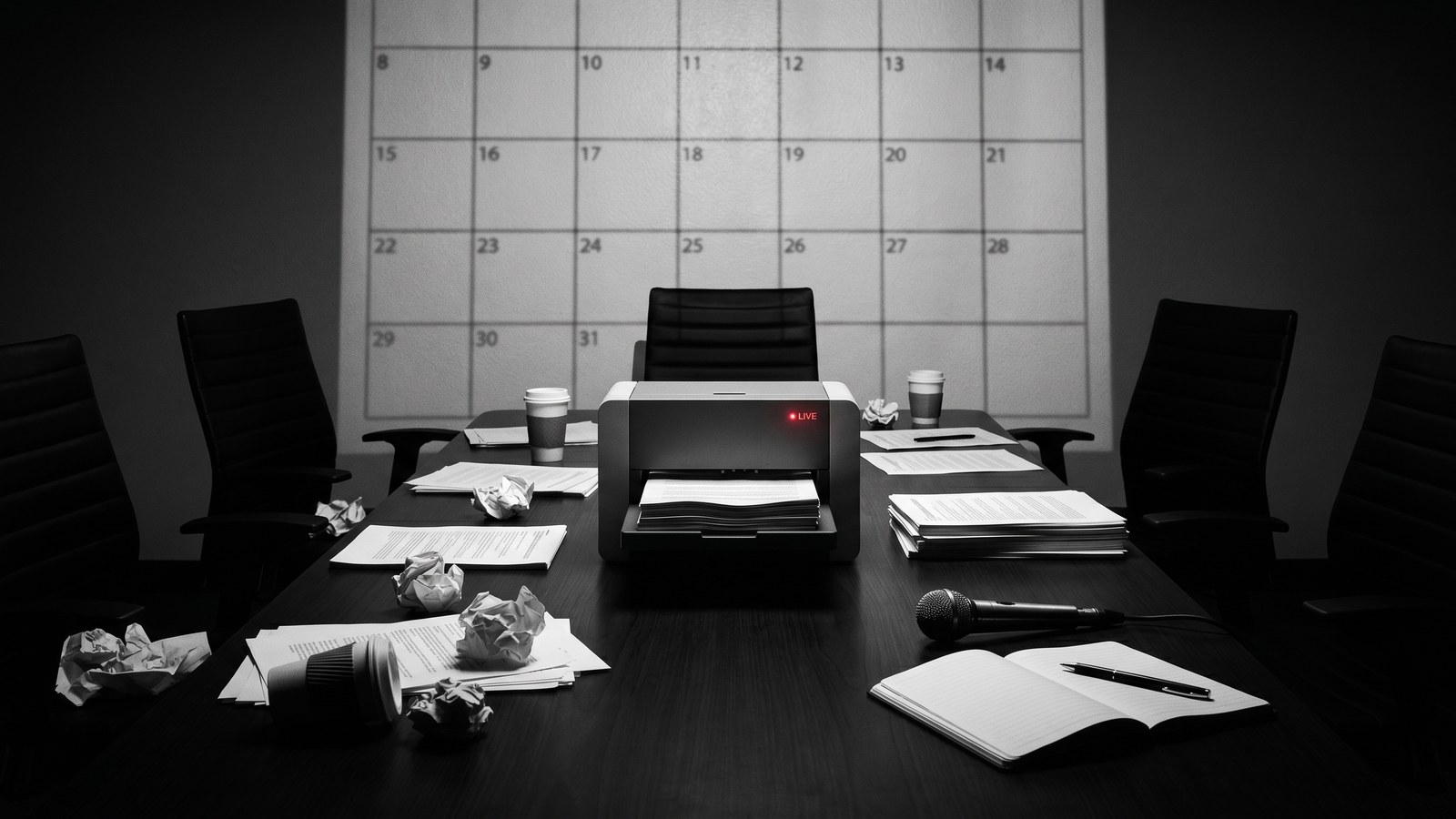
Somewhere along the way, work became a performance.
We filled our calendars with meetings that produced nothing except the next meeting. We wrote reports nobody read, sent updates nobody acted on, stayed late to look committed rather than because the work demanded it. We built organizations that rewarded motion over output and confused busyness with value.
Then AI walked into the room, flipped on the lights, and exposed just how much of it was an illusion.
I didn't fully grasp this until I started building Mornings in the Lab. One morning I watched an AI agent complete — instantly, without complaint — what entire teams used to sweat over for hours. The efficiency wasn't even the remarkable part. The clarity was. It forced a hard question I'd been avoiding: how much of the work I used to celebrate wasn't actually work?
Most of it was activity. Motion. Noise dressed up as productivity.
AI didn't kill those tasks. It revealed how hollow they were to begin with.
What AI Actually Took Off the Table
Let's be specific about what fell away. It wasn't the work that required real judgment or real creativity. It was everything else: compiling spreadsheets, summarizing reports, sorting information, drafting surface-level updates, managing the endless administrative loop that convinces you a day was spent when nothing meaningful moved.
That's the work AI absorbed. And honestly — that's a gift. Not a threat.
Because what it frees up is the work that actually matters: shaping ideas before they're fully formed, asking the question that reframes the problem, making the call when the data is ambiguous, leading people through uncertainty, creating something with genuine intention behind it. The work that requires a human who has something at stake.
AI took the tasks. We get to reclaim the purpose. That's the trade — if you're willing to take it.
The Trap Hidden Inside the Efficiency
Here's where most people get this wrong: they hand everything to the machine and expect brilliance to follow. What they get instead is artificial comfort — a steady output of plausible-sounding work that moves nothing forward. The appearance of progress without any real progress happening underneath it.
AI is not thinking. It is not reasoning from first principles. It is not creating meaning or carrying accountability or sitting with the discomfort of a decision that has real consequences. It is predicting patterns based on what has already been said and done. That is genuinely extraordinary — and it is also genuinely limited.
Leaders still have to supply the judgment. The clarity. The vision. The honest assessment of whether the direction is right, not just whether the execution is clean. AI can amplify who you are. It cannot tell you who your business should become.
What Real Work Looks Like Now
Ironically, AI is making work more human — not less. The tasks it absorbed were never the human part to begin with. They were the overhead. The administrative drag. The organizational equivalent of busywork that everyone participated in because the alternative — having nothing to fill the time — felt worse.
What remains, and what AI cannot touch, is the work that requires a person who is genuinely engaged:
- Creativity — generating ideas that didn't exist before you thought them
- Strategy — deciding what to prioritize when everything feels urgent
- Presence — showing up for a team, a client, a community in a way that is felt
- Judgment — making the call that no algorithm would risk making
- Honesty — telling the truth when a softer answer would be easier
You don't win in this era by doing more. You win by doing what only a human can do — and being excellent at it.
AI Didn't Replace Us. It Exposed Us.
It exposed how much of what we called work wasn't work. How much we leaned on looking busy when being valuable was the harder ask. How uncomfortable we are when stripped of the tasks that protect us from the real work of thinking, deciding, creating, and leading.
But it also opened something. A genuine opportunity to build companies around meaning instead of maintenance, to build teams around outcomes instead of optics, to wake up every morning and actually use your mind for the things it was built for.
AI removed the illusion. Now we get to build something real in its place — and that is a much more interesting problem than any spreadsheet we'll never have to compile again.