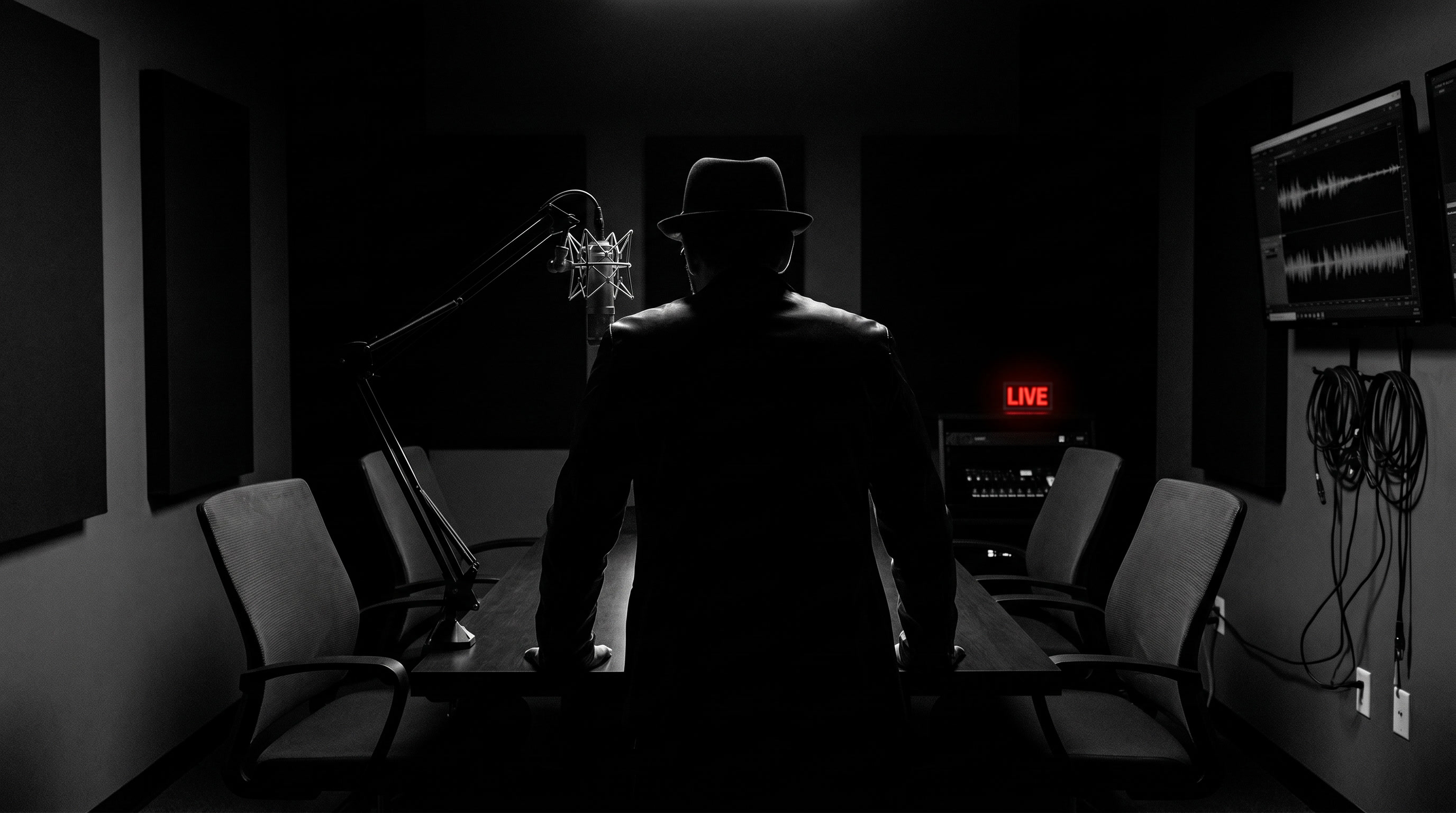
The layoffs are real. The consolidation is real. The major podcast networks that over-hired in the growth years are shedding staff, and the trade press is running the obituary. "Podcasting is in trouble." "The golden era is over." "AI will eat the remaining market share."
That's one story. Here's a different one.
Johnny Flores just hit seven years running Flores Podcast Productions. Not seven years surviving — seven years building. Small business clients. Professional organizations. Concepts developed from scratch, produced end-to-end, positioned for authority. He's not a victim of the media shakeout. He's one of the guys the shakeout is actually clearing the field for.
Because what's collapsing isn't podcasting. What's collapsing is the version of podcasting that was essentially expensive radio — high overhead, celebrity talent, legacy media economics applied to a medium that never needed them. What's left is leaner, more independent, and grounded in something AI cannot replicate no matter how many tokens it generates.
What AI Can Do (and What It Can't)
Let's be direct about the capabilities. AI can generate a decent script for a topic brief. It can optimize a title for search. It can produce show notes, chapter markers, social clips, and email newsletters at a volume and speed that would have required a full production team five years ago. It can, with enough prompt engineering, simulate a cadence that sounds like a real host.
It cannot do the thing that makes someone subscribe and stay subscribed.
The thing that creates a loyal podcast audience isn't production quality. It isn't the title. It isn't even the topic selection. It's the specific judgment of a specific person — their decision about which ideas matter, which guests can actually teach you something, which angle on a subject is the one that cuts through, and which moment in a conversation is worth stopping everything for. That judgment is earned through experience and shaped by personality. It is not transferable to a model.
You know this from your own listening behavior. You don't subscribe to a topic. You subscribe to a person's take on a topic. The difference is everything. A show on entrepreneurship from someone whose judgment you've come to trust over three years is completely different from an AI-generated show on entrepreneurship optimized for the same keywords. You can feel the difference immediately. The synthetic version has all the moves and none of the weight.
Trust Is the Actual Product
What Johnny Flores is actually selling — what any human-hosted show is actually selling — is accumulated trust. And trust is built in very particular ways that don't compress.
It's built through consistency. Through showing up on schedule even when the news cycle is ugly and the motivation is low. Through being honest when you're wrong. Through not pivoting your entire premise every six months based on whatever trend is cresting. Listeners are tracking all of this, consciously or not, and they're deciding whether you're someone whose time is worth theirs.
That process takes years. There is no shortcut. An AI can pump out three hundred episodes in the time it takes a real host to build a genuinely trusted audience. Those three hundred episodes will not build what one hundred real ones do, because they're missing the compounding human element — the evolution of the host's thinking over time, the relationship between the host and their community, the texture of real personality under pressure.
The shows that matter — the ones people actually defend in conversation, recommend to friends, and return to when they need to think through something important — are built on that human infrastructure. Not production infrastructure. Human infrastructure.
The Opportunity Is Clarification, Not Survival
Here's the part that gets missed in the layoff coverage: the collapse of expensive, corporate podcast production is not a threat to independent creators. It's a market clarification that benefits them.
When the major players were throwing money at celebrity deals and production overhead, they were artificially inflating audience expectations for production quality. That era is ending. What's emerging is a more honest market — one where a smart, experienced independent producer or host can compete on the thing they actually own: their judgment, their relationships, and their ability to hold an audience's attention through the quality of their thinking.
Flores saw this before the layoffs accelerated it. Seven years in, producing for businesses and organizations that need to establish credibility and authority in their markets, he's building something that algorithmic content can't displace — because his clients' audiences aren't subscribing to a topic feed. They're subscribing to a person and an organization whose consistency has earned the right to be in their ears.
That's a durable position. Maybe the most durable position left in audio media.
What This Means If You're Building
If you're a creator, founder, or leader thinking about whether a podcast is worth the effort, the honest answer is: it depends entirely on whether you're willing to commit to being the signal.
Not the production. Not the brand identity. Not the strategy. The signal — the actual person whose judgment the audience is tuning in for. If that person shows up consistently, brings real thinking, and is willing to evolve in public over years, you will build something AI cannot touch.
If you're thinking about podcasting as a marketing tactic with a six-month timeline, the economics probably don't work and the AI tools can do that job more efficiently.
The decision is really about time horizon and commitment depth. Short term, high production, trend-responsive: AI wins. Long term, deeply human, relationship-compounding: no contest.
Johnny Flores is still here at year seven because he understood that from the beginning. The medium isn't dying. The pretenders are leaving. That's different — and for the people serious about building, it's actually good news.