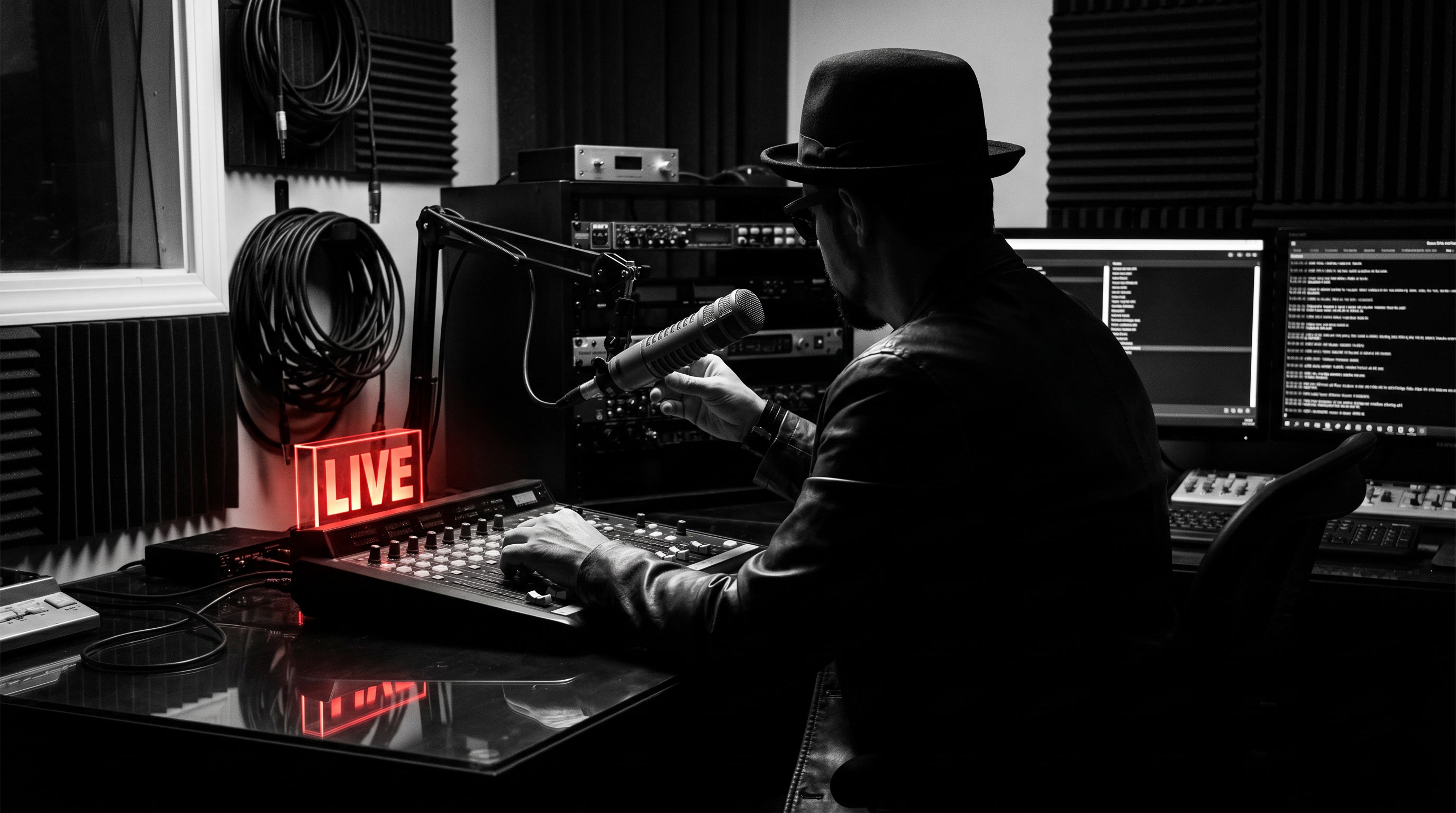
I've been on camera for years. Radio, television, live shows, podcasts, YouTube — I've done the circuit. And the number one question I get from creators trying to build something is some version of: how do I get comfortable on camera?
The honest answer is boring. You press record. You do it badly. You press record again.
That's it. That's the whole framework.
Nobody Finds Presence. They Build It.
When you watch someone who is genuinely magnetic on camera — calm, certain, alive — you're watching the output of hundreds of hours of recorded discomfort. You're watching the accumulated weight of every awkward take, every cringe-worthy replay, every moment they almost quit and didn't.
Presence is not a personality trait. It's not charisma you were born with. It's a skill, and like every skill it only develops under conditions of repeated practice with genuine stakes attached.
The stakes matter. Practicing in your living room with the camera off is not the same thing. Posting the video — putting it out there, letting it be seen — that's where the growth actually happens. The feedback loop only works if you close the loop.
The Camera Doesn't Lie, But It Also Doesn't Judge
Here's what most men get wrong when they first start recording themselves. They watch the playback and they see every flaw simultaneously. The stiffness. The filler words. The weird thing they do with their hands. And they interpret all of that as evidence that they are not the kind of person who can do this.
That's backwards.
That discomfort, that awareness of your own awkwardness, is the first stage of building real presence. You can't fix what you can't see. The men who never watch their playback never improve. The men who watch it, feel the cringe, and come back tomorrow — those are the ones who eventually become undeniable on screen.
The camera is not your enemy. It's your most honest coach.
You're Not Talking to a Camera. You're Talking to One Person.
One of the mechanical shifts that changes everything: stop addressing the audience as a crowd. There is no crowd. There is one person — the right person — watching you, and they need to hear what you're about to say.
When you talk to a crowd, you perform. You go broader, louder, more generic. You start hedging and covering your bases. The energy leaks out.
When you talk to one person, you get specific. You lean in. You say the thing you actually mean. And ironically, that specificity is what makes the widest audience feel personally addressed. The more precise you are, the more universal it lands.
Think about the person you're making this for. Not your potential subscriber count. One real human being who has the exact problem you're qualified to talk about. Now say something worth their time.
Your Environment Is a Message
Before you've said a single word, your setup has already made a statement about who you are. It tells the viewer whether you take this seriously. Whether you respect their attention. Whether you've thought about what you're building.
This doesn't mean you need a $10,000 production setup. It means you've made a decision about your space, your light, your frame, your look. The absence of a decision is a decision. A cluttered background with a blown-out window isn't neutral — it signals that this is an afterthought.
Intention communicates. Even the small things.
The Post Button Is Part of the Practice
There is a version of camera practice that never ends, never ships, never contributes to growth. That's the version where you record everything and post nothing. Where you're always refining but never risking. Where the goal is comfort instead of the thing comfort is supposed to produce: connection with an audience.
Post it. Not when it's perfect — it won't be. Post it when it's honest. When it actually sounds like you. When it says something real.
The video you post today, imperfect as it is, becomes the foundation the next video is built on. The only way forward is through the one you're avoiding right now.
Press record. Stay in the frame. Do it again tomorrow.
Presence doesn't arrive. It accumulates.